What's the Vibe? How Mood Targeting Improves Your Ad Timing.
Context is everything. With contextual solutions like mood targeting, you can reach the right audiences without relying on declining identifiers and while maintaining privacy.
Imagine this: You’ve got an awesome new product. You know millennial men will love it. And it’s the kind of thing they’re most likely to need mid-day when the coffee is flowing and they’re the most energetic. So, you’re understandably excited to pitch it to this demographic. But what happens when your high-energy ad reaches those millennial consumers when they just want to chill and relax? Suddenly, your ad is a mismatch with your target audience’s real-time mood.
As the saying goes: Context is everything. And that’s where mood targeting comes in to save the day (and your campaign).
Mood informs ad timing
Our mood targeting is a contextual solution that allows brands to better understand the situations and emotions their ads are likely to play into. Mood targeting can help you get everything from audience to timing to messaging right.
Music plays a powerful role in people's lives. It improves listeners’ moods (78%), relaxes them (75%), and makes them happy (74%). 1 With mood targeting, you can meet audiences where they are with messages that are more likely to get attention and inspire action.
Moods increasingly matter in the privacy era
As consumers become savvier about data collection and their privacy, the advertising industry is experiencing a massive shift. The decline of third-party cookies and mobile advertising IDs (MAIDs) means marketers can no longer rely on traditional behavioral tracking, which could threaten both revenue and the ability to personalize.
Advertisers are now caught in a tricky spot: Consumers expect highly personalized experiences, but they don’t want to like they are being watched. This is exactly where contextual solutions like mood targeting shine. By using real-time signals like listening device data, music preferences, and time of day instead of additional personal identifiers (collected through consented data), mood targeting delivers customization while respecting privacy regulations. You can still reach listeners in meaningful, relevant moments—just without the cookie crumbs.
Up the relevance, reap the rewards
When advertisements align with a listener's current vibe and mood, your campaign results have a better chance of being successful. Listeners are highly receptive to messages that fit seamlessly into their audio experience, with 76% of consumers being more likely to pay attention to ads that feel relevant to them. 2 Furthermore, 72% of consumers would be less likely to pay to remove ads if those ads were targeted and interesting. 2 Not all consumers are ad-averse, they just want to be fed the right kind of ad that warrants their attention.
Pair mood and activity targeting together
Moods don’t exist in a vacuum; they can be affected by what someone is doing. That's why pairing mood targeting with activity targeting unlocks an even richer understanding of your listener. By marrying action with emotion, advertisers can create hyper-relevant moments that drive powerful brand connections.
Think about a consumer streaming chill music while lounging on their couch on a Tuesday evening. They're likely winding down mentally after a busy day, making that an ideal moment for messaging around convenience, calm, or routine. Compare that to a listener streaming an energetic playlist during their workout. That's a completely different mindset, one that can respond well to high-energy messaging, aspirational language, and brands tied to performance or reward.
See the results for yourself: SiriusXM Media boasts a 73%+ validation rate for activity and mood targeting, so you can rest assured that you’re in expert hands. 3
Reach audiences with the right message
You don’t have to limit yourself to a single mood to promote your brand or your products. One ad might work for both happy and celebratory mood targeting. But why not use different ad creative for listeners who are feeling angsty and another for those in a more serene headspace? Just as advertisers might tweak or overhaul creative to reach certain demographics or markets, the same goes for mood.
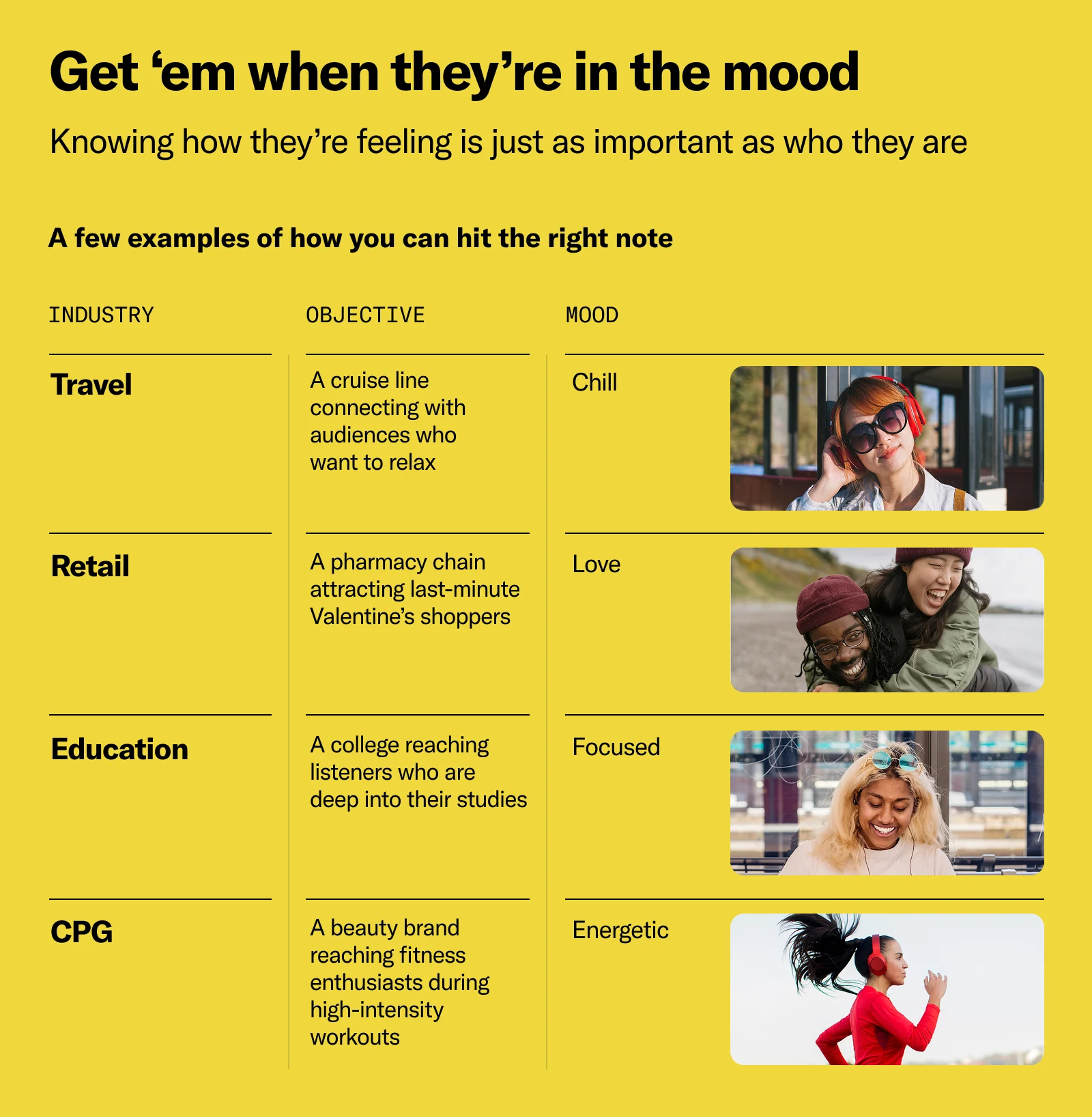
For example, a CPG brand might develop an ad for a new line of body washes. Using various ads to target multiple moods, it might start off promoting its invigorating scents to target the energetic mood, followed by an ad promoting the line's all-natural ingredients for the soothing mood, and finished with another ad about how soft it makes skin feel for the love mood.
All of this and more is possible when you work with our in-house audio agency, Studio Resonate, especially if you lack creative support or don’t know where to begin. Working with an audio agency can help you craft custom ads that fit the vibe (no matter what it is).
Put your ads in the right context
Mood targeting isn’t just about getting your ad into the context of the right content. There is also an opportunity for brands to build ads that feel integrated into the content they support. And understanding the type of music the audiences are listening to can fuel creative decisions. Looking back at the CPG brand, the creative for each mood can incorporate elements and sound effects that work well with music, the scripts can use scenarios and language that align with the vibe, and voiceover artists can modulate their tone and tempo—all to build an ad that becomes a part of the listening experience.
Proven tips for compelling mood-targeted ads
Developing creative that matches the mood requires a thoughtful approach to audio production. Ads that align with the listening environment consistently perform better than disruptive, traditional radio-style spots.
Previously, Studio Resonate and our ad effectiveness team analyzed 22 audio ads to determine what makes a brand message successful. Not surprisingly, ads that aligned well with the content and listening environment performed better. Here are some things to keep in mind as you develop ads for mood targeting.
Match the energy. When it comes to audio ads, you have to match the energy. High-energy stations like Happy call for faster pacing and dynamic delivery. Meanwhile, stations like Sleep and Relaxing work better with a softer voiceover, slower tempo, and relaxed music. Focused or productive moods can respond well to simple, to-the-point messaging that doesn't compete for attention.
Put the listener first. Mood scoring gives advertisers an indication of how listeners are feeling when they tune in. Brands can leverage that knowledge to create ads that meet the listener where they are, whether that’s laid back or exploding with energy.
Keep ad copy conversational and authentic. A conversational tone is key in digital audio environments (no radio-style disruption here, please). But what is conversational and what feels authentic is subjective. Mood targeting can help advertisers align the tone of their copy to work within the context of the musical content.
Use sound effects, music, and voiceovers strategically. Audio advertising allows brands to tell immersive stories that transport the listener—but the journey shouldn’t be jarring or bumpy. Aligning creative choices to mood can make your ads sound like an extension of the content your consumers are already enjoying.
Read the room, then run the ad
There’s more to humans (aka your target consumers) than geographics, demographics, time of day, and life stage. We have feelings, preferences, opinions, and more that inform who we are and how we make decisions just as concretely as who we appear to be on paper. That’s where mood targeting comes in to help advertisers speak to all the complex elements that make up their audiences. And with this kind of contextual advertising, you can reach your right audiences without relying on declining identifiers.
We can help you nail the right audience, timing, and vibe. Let’s talk.
More contextual targeting insights



Related Insights
 Targeting
Activity Targeting Gets Your Brand Messages in on the Action
Oct 16, 2026 Digital Audio
It's Not Too Late to Win New-to-Brand Holiday Buyers with Audio
Oct 15, 2026 Digital Audio
Why Fragmented Consumer Attention is Changing Media Buying
Oct 14, 2026 Success Stories
SiriusXM Drives Cross-Funnel Lifts for a Breakfast Brand
Oct 13, 2026
