How Multitasking Consumer Behavior Is Changing Media Engagement
Explore how multitasking consumer behavior is changing media engagement and why digital audio helps advertisers reach audiences beyond the screen.
For many years, more was the whole point: More channels, more devices, and more always-on access. Today, that abundance has transformed how consumers engage with media. Picture someone watching their favorite show while scrolling through social media, shopping online, or texting a friend. Sound familiar?
This is called second-screen behavior, and it’s exactly what it sounds like—a phone out during a TV show, a social feed open mid-stream, shopping while an episode plays in the background. As consumers divide their attention across devices, platforms, and activities, advertisers face a growing challenge: How do you capture attention when audiences are rarely focused on just one thing?
At the same time, consumers are increasingly craving a break from their screens. In fact, 81% of Gen Z adults and 78% of millennials say they wish they could disconnect from their digital devices more easily. 1But wanting to disconnect doesn’t mean a lack of desire to connect and be entertained.
That’s where audio stands apart. Unlike visual media, streaming audio and podcasts don't require consumers to keep their eyes on a screen. Whether they're commuting, working out, tackling household chores, or simply putting their phones away, listeners can stay connected to the content they love. Explore what these changing behaviors mean for media engagement—and why audio deserves a place in the mix.
Why multitasking consumer behavior is reshaping digital media consumption
Media consumption is no longer a standalone activity. Consumers scroll through social media while watching TV, stream podcasts during their commutes, and listen to music while tackling household chores. They're increasingly layering media into their everyday routines. Let’s add in the fact that streaming TV, social media, and connected devices have made always-on access the default, so the consumer can dip in and out at any moment.
The average household now juggles more than five video streaming services, and almost half of adults 18 and up (48%) say they have a hard time keeping up with them. 2 Linear TV has felt it, too. Viewership dropped below a 50% share for the first time in 2023, 3 and consumers are spending 43% less time consuming TV. 4
That's where digital audio offers a distinct advantage. Unlike screen-based media, streaming audio and podcasts don't require visual attention, allowing consumers to stay connected to content while going about their day. It shows up in the moments a screen simply can't: vacuuming, scrubbing dishes, or exercising. As multitasking becomes an increasingly familiar part of media consumption, advertisers have an opportunity to reach audiences beyond the screen and build connections across more moments.
How second-screen behavior impacts advertising engagement
Second-screen behavior may have once been associated primarily with younger generations, but it's quickly becoming the norm across age groups. It’s been found that second-screen usage among adults 45-54 jumped to 52% in 2025, up from 39% just three years earlier. By 2027, an estimated 81.9% of the US population will be doing it. 5
For advertisers, this shift presents a growing challenge. When consumers scroll through social media while watching TV or browse online stores while streaming content, their attention is divided between competing screens. As a result, visual ads may struggle to capture attention, potentially limiting message retention and ad recall. An impression might be delivered, but that doesn't necessarily mean the message was noticed.
Meanwhile, with audio, it doesn’t require consumers to look at a screen. In fact, 79% percent of listening happens when visual media isn't even available, so the message gets through no matter where someone's eyes and thumbs are. 6
Why passive media consumption changes campaign performance metrics
When audiences are multitasking and dividing their attention, the numbers get murky. Impressions and reach don’t always tell brands whether a message resonated, and advertisers are left needing a way to measure attention quality, not just exposure. Metrics like ad recall, brand lift, and purchase intent can help paint a clearer picture of campaign impact.
Audio has an edge here. Listeners build their own mental picture of an ad instead of passively receiving one, creating what’s known as the "theater of the mind" effect. This can help strengthen brand connections, even during multitasking moments. We’ve found that audio ads have beaten benchmarks across video, TV, display, and social media by more than 50%. 7
How brands adapt advertising strategies for multitasking audiences
There's no single fix for reaching an audience this fragmented, but a handful of strategic shifts can help advertisers capture attention and drive engagement.
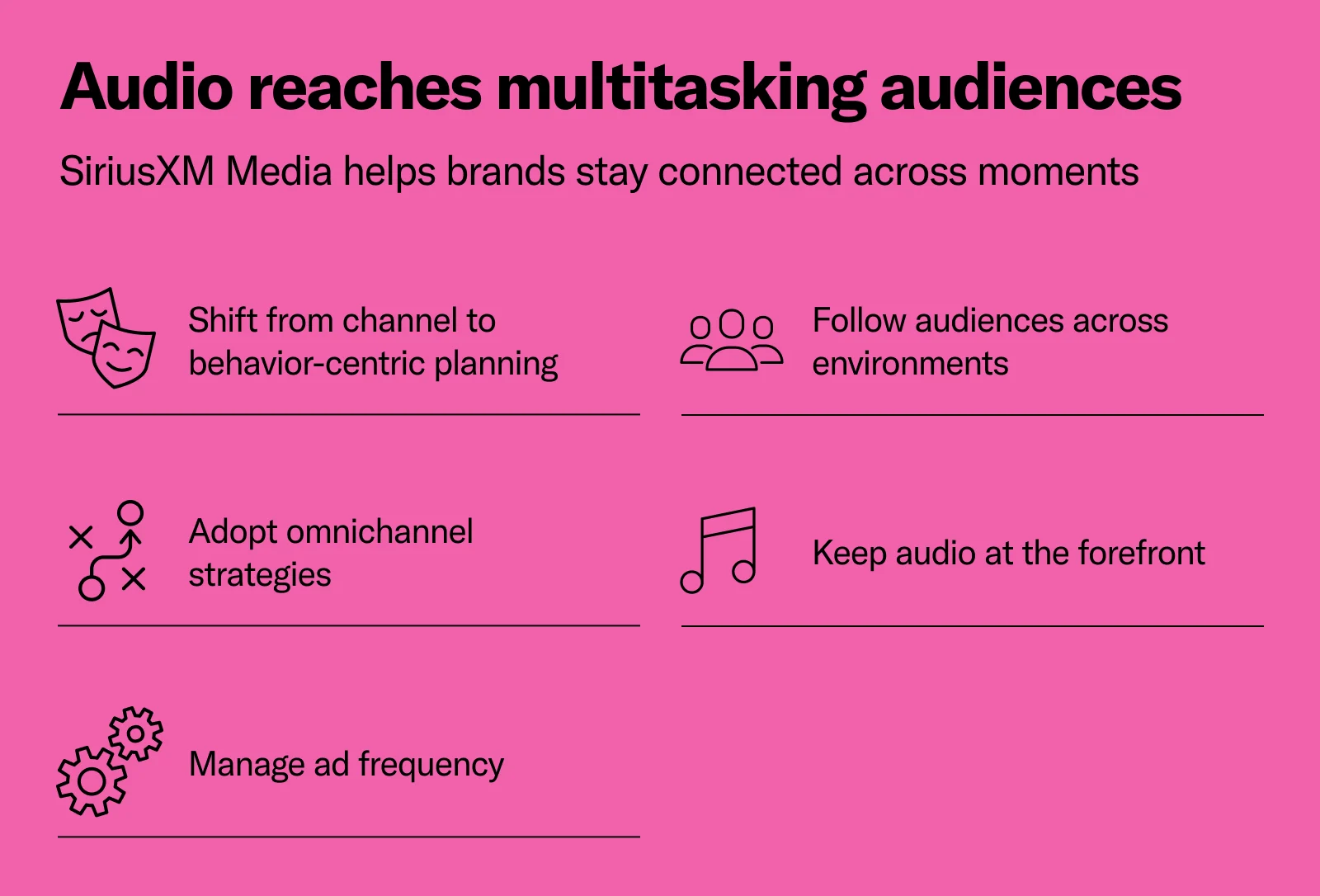
Shift from channel- to behavior-centric planning
Skip the platform-first approach. Map out how consumers move between devices, platforms, and activities throughout the day, then build the media plan around those specific moments instead.
Follow audiences across environments
The customer journey doesn't belong to any one platform anymore. Someone might start their morning with a podcast, switch to talk radio on their commute, and wind the day down with music at home. A campaign that isn't built to be cross-platform is only catching one slice of that journey.
Adopt omnichannel strategies
Combining channels and formats can extend reach and reinforce messaging. Adding video and display to an audio-only campaign with SiriusXM Media delivers +52% incremental reach. 8 Additionally, layering streaming audio plus podcasts onto a SiriusXM campaign can boost incremental reach by as much as +142%. 9
The results extend beyond reach. In a past campaign, we worked with a telecom advertiser, combining display, sponsored content, audio, and video ads across streaming audio and podcasts. The campaign achieved a 10-point lift in brand favorability and an 8-point lift in online ad awareness. 10 Beyond this campaign alone, research has also shown that including audio in an omnichannel mix can deliver 3.4x greater connection and 1.9x greater immersion than campaigns without it. 11
Keep audio at the forefront
Audio reaches consumers during everyday moments when screens aren’t always practical, so it deserves a central role in a multitasking strategy. That reach just expanded even further: SiriusXM Media is now the exclusive advertising representative for YouTube's audio ad inventory in the US, giving advertisers access to more than 212M monthly YouTube and YouTube Music listeners. 12
Manage ad frequency
More touchpoints mean more chances for ad fatigue, so frequency has to be managed strategically. We previously found that across 170+ brand studies, four or more ad exposures produced the highest brand awareness. 13 The answer isn't simply fewer impressions. It's finding the right balance of frequency, creative variety, and messaging to reinforce brand awareness without wearing out audiences.
Improve audience engagement with SiriusXM Media
People aren't going to stop splitting their attention across screens, tasks, and platforms anytime soon. For advertisers who’ve historically relied on visual media, that presents a growing challenge. But digital audio offers a way to reach consumers even when their eyes are elsewhere. As multitasking consumer behavior becomes an increasingly common part of media consumption, audio belongs at the center of any cross-platform strategy, helping brands connect with audiences throughout their daily routines.
Ready to reach audiences across more moments that matter? Let's chat.
More audio advertising insights



Related Insights
 Success Stories
Beyond Awareness: Streaming Audio Drives Auto Sales Lift
Oct 28, 2026 Digital Audio
How Multitasking Consumer Behavior Is Changing Media Engagement
Oct 27, 2026 Podcasts
Podcast Picks: Celebrating Hispanic Heritage
Oct 23, 2026 Digital Audio
Why Attention Quality is More Important Than Impression Volume
Oct 21, 2026
