When to Prioritize Audio Advertising Over Social and Display
Learn when to prioritize audio advertising over social media and display to reach multitasking audiences, boost attention, and drive full-funnel results.
In today’s attention economy, every advertising channel is competing for a limited—and increasingly fragmented—share of consumer attention. Social media and display advertising are powerful ways to reach audiences, but there are moments when audio can outperform visual formats by capturing attention without requiring a screen. Understanding the specific conditions that favor audio over social media and display ads allows you to allocate budgets more strategically and justify those decisions to stakeholders with confidence.
Audio has many strengths over display and social formats. But that doesn’t mean it should be a replacement. After all, all three channels can work together. But audio has a distinct advantage: It can reach audiences during screen-free moments, in more places, and at more points throughout the day.
Think of audio as the connective tissue across a consumer’s routine. It can extend your message beyond billboards, social feeds, and display ads, reaching listeners when they’re exercising, cooking, or simply taking a screen break. When attention is increasingly difficult to earn, those screen-free moments give advertisers another opportunity to stay present without adding another visual demand.
What makes audio advertising different from social and display?
The fundamental difference between audio, social, and display lies in the consumption context. Social media marketing operates in environments where users are multitasking, scrolling quickly, and often ignoring ads entirely. Display ads appear alongside other visual content, competing for limited screen space. Audio advertising, by contrast, reaches listeners during activities where screens are inaccessible or secondary—during commutes, workouts, household tasks, or work sessions.
Go beyond basic demographics
Social, display, and audio platforms all give brands sophisticated ways to reach relevant audiences. And the signals behind that targeting can overlap. But what sets audio apart is the additional insight that can come from listening behavior and context. Alongside demographic, audience, and behavioral signals, audio platforms can use first-party listening data and contextual signals to help advertisers understand not only who they’re reaching, but also what content they’re engaging with and the listening moments surrounding that engagement.
When users engage with streaming audio platforms, brands gain access to first-party data without relying on invasive tracking methods. This turns into first-party signals that brands can use to reach people based on their favorite music genre, content preferences, device usage, and time of day.
Just look at Pandora, which has over 20 years of logged-in, first-party user data and more than 1B signals enriching its audience dataset. Additionally, SiriusXM Media’s first-party data is 3.8x more accurate than that of other publishers. 1
Meet listeners based on what they're doing and feeling
With digital audio, you can reach listeners with contextual targeting and match their mood, activity, or listening context. For instance, an athleisure brand can target listeners when they're at the gym and thinking of new gymwear. Meanwhile, a meal delivery service can connect with parents who have dinner on their minds as they’re picking up their kids from school. And with mood targeting, you can align creative with moments when listeners are feeling energized, focused, or relaxed. Your message fits naturally into what's already happening.
This contextual advantage translates to better attention. When someone is listening to a podcast or streaming music, they have made an active choice to engage with that content. Audio ads become part of that listening experience rather than an interruption to be scrolled past.
Build for a privacy-forward future
As third-party cookies continue to decline and consumer privacy expectations evolve, audio's wealth of first-party and contextual signals positions it well for what's next. For advertisers, that creates a privacy-forward way to maintain relevance: using the signals listeners provide through their relationship with an audio platform and the context surrounding the listening experience to deliver more meaningful ads.
When to prioritize audio advertising over social and display
Choose audio over display ads when viewability concerns undermine your display performance, when your message requires more than a visual glance to communicate, or when you need to reach audiences in contexts where display simply cannot appear. Display ads and audio ads serve different functions, and understanding when to shift budget toward audio ensures your media mix reflects actual audience behavior.
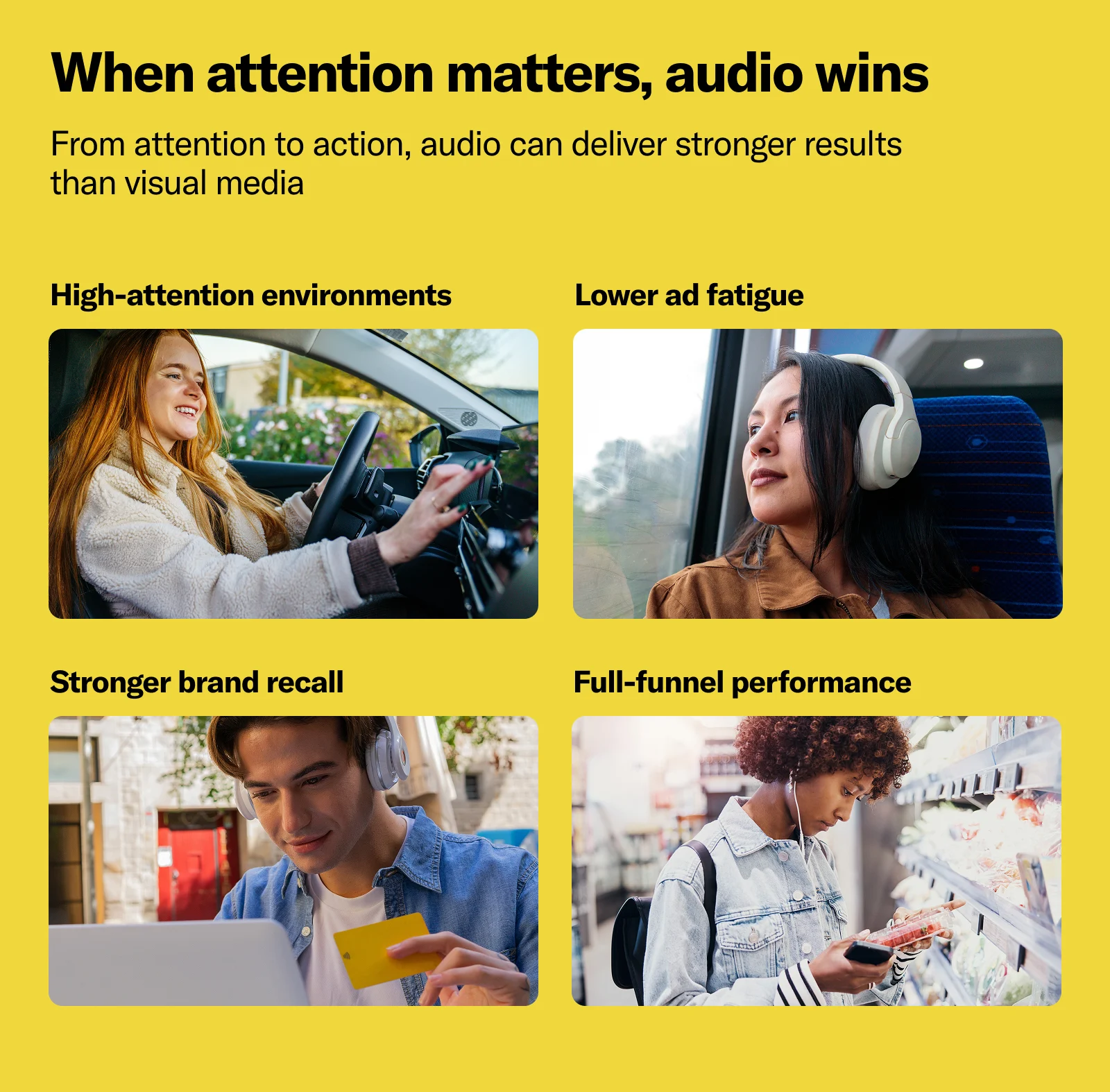
When attention is scarce, audio has a key advantage. Audio ads have been shown to outperform benchmarks across video, TV, display, and social by more than 50%. 2
Catch listeners in high-attention environments
Let's be honest: It can be easy to ignore visual ads. One might scroll past social ads without a second thought or barely register banner placements on a news site. Meanwhile, audio reaches people when their eyes and hands are busy: commuting, exercising, cooking, working. In fact, 79% of audio consumption happens when visual media isn't available. 3
And it's not just that visual media is cluttered. Some consumers are also spending less time with it. Linear TV viewership dropped below a 50% viewing share for the first time in 2023. By comparison, digital audio platforms have captured a growing share of daily listening: Streaming audio has grown by +67%, YouTube has grown by +85%, and podcasts have grown by +367% over a 10-year period. 4
Reduce ad fatigue and visual saturation
Think of this scenario: When you see a cluttered feed, you’re highly likely to tune out the many ads fighting for your attention. Audio is different, offering brands another way to stay present without adding another visual demand.
More than half of streaming audio listeners (58%) say audio helps them escape from too much visual stimulation. 5 Digital audio can also help advertisers manage ad fatigue through precise targeting, varied creative, dynamic audio, and frequency management—all of which can make messages more relevant and reduce unnecessary repetition. And while audio ads aren’t immune to ad fatigue, they’re also not competing with a dozen other things on the screen. They just have to be worth listening to.
Build stronger brand recall
Audio is tied to memory and emotion in ways that social and display ads can't replicate. In fact, 83% of listeners say music triggers nostalgia and 75% say it relaxes them. 6 When your ad shows up during those nostalgia-triggering moments, your brand benefits from that positive association and brand recall. For advertisers focused on upper-funnel performance, that ability to stick matters.
That memorability can also make audio a valuable partner to visual channels. A consumer might first hear your message while listening to music or a podcast and later recognize the brand when they encounter it in a social feed or display placement. Rather than asking each channel to work independently, advertisers can use audio to reinforce messaging across the broader media mix.
Drive full-funnel performance
There's a misconception that audio only works for top-of-the-funnel campaigns, but that's not true. Advances in targeting, adtech, and measurement have made digital audio a full-funnel channel capable of supporting everything from discovery and consideration to purchase and conversion. Take a look at the data: 77% of digital audio listeners have potentially purchased a specific brand, product, or service after hearing an audio ad. 7 And 66% say audio ads are key to influencing their purchase decisions. 8
How audio reaches audiences social and display miss
Extend reach beyond screen-based media
Incremental reach is about finding consumers your existing media mix isn't reaching—or reaching them in moments when other channels aren't present. Audio is particularly well suited to do both. But remember, audio doesn't have to compete with social and display. Instead, it can fill the gaps between them, extending a campaign into more of the consumer's day and creating additional opportunities for a brand's message to connect.
Connect with ad-avoidant audiences
On social and visual channels, users can scroll past your ad in a fraction of a second or mentally block ads entirely. Meanwhile, audio creates a different experience. Ads are integrated into the listening environment, allowing brands to reach consumers without relying on a viewable display placement or requiring them to stop what they're doing and look at a screen.
This makes audio an important complement to visual channels—especially when advertisers want to diversify their media mix beyond environments where consumers have become accustomed to quickly scrolling or clicking past ads. And the relationship can work both ways: Social can extend an audio campaign through creator posts, clips, and other shareable content, while audio gives brands access to the deeper creator-listener relationships built through music and podcasts.
Build connections with loyal podcast listeners
Podcast audiences have a unique relationship with the hosts they listen to, and those positive associations extend to brands. Nearly a third of podcast listeners say they feel more trust towards brands that sponsor their favorite podcasts repeatedly. 9 And one-third of listeners support brands that support their favorite shows. 10
How to evaluate your campaign for audio advertising fit
Audio matches full-funnel goals
Whether you're focused on awareness, consideration, or driving purchases, audio delivers on all fronts. We’ve found that audio campaigns can drive a +8% increase in ad awareness, a +5% increase in message association, and a +3% increase in both purchase intent and brand favorability. 11 And at the bottom of the funnel, 53% of ad-supported audio listeners have taken action after hearing an ad, whether that's searching for more information, using a promo code, or making a purchase. 12
The right role for audio depends on your objective. If you're focused on brand-building, audio can create memorable experiences through sound, storytelling, and repetition. If you're focused on consideration or conversion, targeting and measurement capabilities can help connect audio exposure to actions later in the customer journey.
Use audio to complement social and display
In some campaigns, the real power comes from using audio, social, and display together. Each format gives consumers another opportunity to encounter and remember your message across different environments.
For instance, audio can reinforce messaging when consumers step away from their screens, while social media can drive visual engagement and interactions, and display can provide additional visual touchpoints across the web. Together, these channels can reinforce a consistent message without relying on a single format or environment to do all the work.
Advertisers can also extend their campaigns across formats within the SiriusXM Media ecosystem. Adding video and display ads to an audio-only campaign with SiriusXM Media delivers +52% in incremental reach. 13When you combine channels thoughtfully, you keep your brand present across multiple environments without overwhelming the consumer.
Prioritize the right channels for campaign success
Audio has clear strengths: It reaches people when screens can't, and it works across the funnel. But keep in mind, it's not always a replacement for social and display. All three formats can work together depending on your goals, with audio filling in the gaps that visual media leaves behind.
When you’re ready to go all in on audio, let's talk.
More audio advertising insights


Related Insights
 Targeting
What's the Vibe? How Mood Targeting Improves Your Ad Timing.
Oct 8, 2026 Events
Follow the Fandom: Inside the Built with Audio Event
Oct 7, 2026 Digital Audio
Audio Built for Every Kind of Audience
Oct 7, 2026 Podcasts
Serialously and 10 to Life Join SiriusXM Media: Meet Annie Elise
Oct 6, 2026
