A Guide to Attribution: Multi-Touch vs. Cross-Channel
In the early days of digital advertising, measurement was relatively a straight line. A consumer saw a banner ad, clicked it, and bought a product. This approach is often measured through single-touch attribution, and for a while, it worked.
Today, the modern consumer journey is far from linear. It’s a multi-device experience spanning morning podcasts or music playlists, midday social media scrolling, and evening TV show or YouTube streaming. As brands adopt omnichannel campaigns to reach consumers across touchpoints, relying solely on single-touch or last-touch attribution leaves gaps in understanding campaign performance. If you give 100% of credit to the last touch/click, you risk not knowing the full story of how your consumer got there and the touchpoints that had the most impact on their decision.
To gain a more complete view of the customer journey—and better understand how channels work together to drive results—brands are increasingly turning to multi-touch and cross-channel attribution.
What is multi-touch attribution (MTA)?
MTA is a measurement technique that assigns credit across every touchpoint a consumer encounters on their path to conversion. Unlike single-touch or last-touch models, MTA recognizes that conversions are often influenced by a series of touchpoints working together across environments. It provides a realistic view of your campaign’s impact on consumer behavior.
MTA in action
Imagine a young professional preparing for a move. While streaming music on Pandora one day, she hears an ad for a furniture brand. Two days later, she sees an ad for that same brand while watching the Call Her Daddy podcast on YouTube. Somewhere in between, she scrolled past a social media ad featuring the retailer’s latest collection.
When she finally visits the retailer’s website to buy a new sofa, a single-touch model would only credit that final click that led to the sale. However, MTA reveals which digital touchpoints truly influenced her conversion and how each interaction impacted the customer journey.
What’s in it for advertisers?
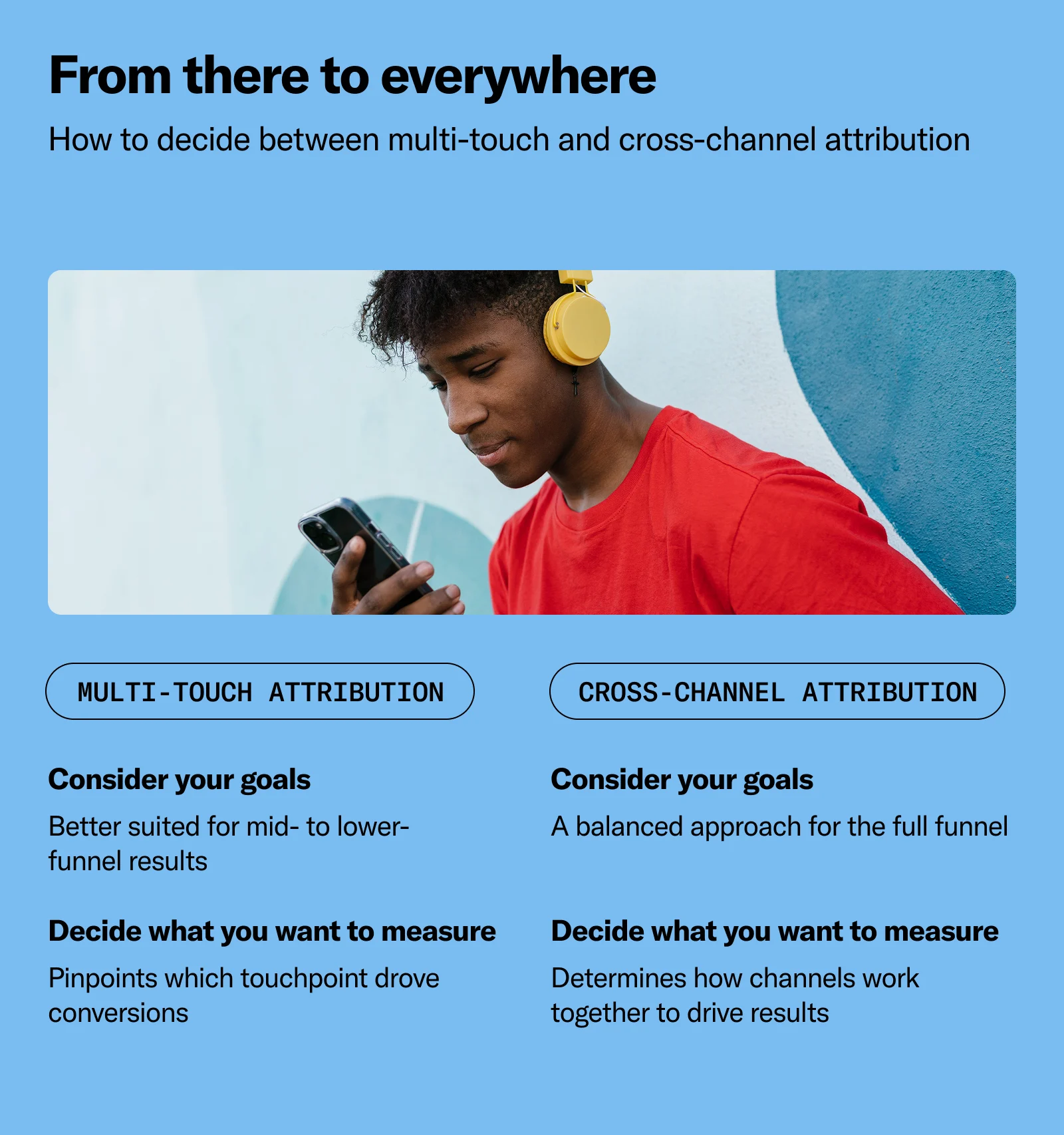
MTA is ideal for measuring mid- to lower-funnel impact. By defining which digital touchpoints deliver the most value, you can better optimize your budget and improve ROI and incremental ROI for live campaigns almost as it happens.
What is cross-channel attribution?
While MTA focuses on individual digital touchpoints that lead to conversions, cross-channel attribution zooms out to look at the bigger picture. It evaluates how various marketing channels work together to influence performance across the customer journey. Rather than evaluating touchpoints in isolation, it reveals the combined impact of channels like audio, social media, search, and connected TV (CTV).
Market Mix Modeling (MMM) is a prime example of cross-channel measurement approach. Instead of focusing on user-level clicks or identifiers, it uses aggregated data to forecast the overall impact of your media channels. This makes it particularly useful for measuring channels that are difficult to capture through traditional digital attribution methods, including streaming audio, podcasts, and CTV.
What’s in it for advertisers?
Cross-channel attribution isn’t limited to a specific part of the funnel; instead, it provides a broad view of marketing performance across the entire journey. It helps answer questions like:
How much incremental value does podcast advertising add to my media mix?
Does streaming audio increase branded search activity or website traffic?
How do changes in one channel affect performance in another?
Which combination of channels drives the strongest business outcomes?
Which attribution type is right for my campaign?
There isn’t a one-size-fits-all answer. Here are a few pointers on how to choose an approach based on your specific needs, measurement priorities, and campaign objectives.
Consider your campaign goals
If your goal is to drive immediate action, like app downloads or product purchases, MTA is better suited for those results. If you are looking for a full-funnel, balanced view of how your ad spend is impacting long-term outcomes, cross-channel attribution is the way to go.
Decide what you want to measure
The next question is: Do you want to know what specifically drove your customers towards the purchase? Or do you want to explore deeper ties among different channels and how to use them together to their fullest? For more granular insights on user engagement, go with MTA. For a broad, holistic view of your entire media mix, go with cross-channel attribution.
Take on a hybrid approach
The best advice? Master them both and use each one based on its strengths. Get the granular insights needed for quick digital optimization via MTA. Meanwhile, cross-channel attribution provides the broader context needed for media planning, budget allocation, and long-term strategy.
Together, these approaches create a more complete picture of marketing performance, allowing advertisers to optimize individual touchpoints while also understanding how their entire media mix works together to drive results.
Where does audio fit into attribution?
Audio plays a valuable role throughout the customer journey, from building awareness and consideration to influencing purchase decisions. This channel is critical to your marketing (and measurement) strategy.
Yet, historically, audio has often been undervalued in attribution models. Many traditional attribution approaches were built around clicks and other direct digital interactions, making it difficult to fully capture the influence of channels like streaming audio and podcasts. As a result, audio has sometimes received less credit than it deserves, despite its ability to drive meaningful business outcomes.
Fortunately, the gap is closing, and we know how to measure your success. Through partnerships with independent vendors like Magellan AI, Innovid, and Transunion, we offer pixel-based multi-touch measurement that matches ad exposure to real-world conversions.
And for marketers using MMMs, we provide the data feed technology required to better understand audio's contribution within a broader cross-channel strategy. These solutions help advertisers evaluate how streaming audio and podcasts work alongside other channels to drive business results.
Whether you're looking for granular conversion insights through MTA or a holistic view through MMM, audio can and should be part of the measurement conversation. The result is a more complete understanding of campaign performance—and greater confidence in the role audio plays across the marketing funnel.
Unlocking the ROI of audio for a global hotel brand with MMM
Now that we’ve covered the theory, let’s look at real-world results. A global hotel brand partnered with us to tackle lower-funnel goals: driving conversions, delivering ROI, and increasing response rates.
To prove that audio drives business results and to conduct an incremental analysis, our client turned to MMM. By feeding the model the clean data we provided, they were able to break out performance across different media types and products.
Here’s how it played out: 1
142 ROI index for SiriusXM
120 ROI index for podcasts
107 ROI index for streaming audio
This success story comes with a few clear takeaways. First, audio deserves your investment. Second, audio has an undeniable impact. And third, when measured correctly, you can see the results with your own eyes.
Get started with SiriusXM Media
Modern campaigns are increasingly complex, and measurement strategies need to evolve alongside them. Whether you’re looking to understand which touchpoint influenced a conversion or uncovering the impact of streaming audio and podcasts within your media mix, we have the right expertise and partners to help you succeed.
Ready to drive results with audio (and properly measure them)? Let’s chat.
More measurement insights


Related Insights
 Success Stories
Audio Drives Awareness and Demand for Toyota Electrified Vehicles
Jul 21, 2026 Digital Audio
A Guide to Attribution: Multi-Touch vs. Cross-Channel
Jul 20, 2026 Podcasts
The Unwell Network’s Big Year Means Big Wins for Brands
Jul 16, 2026 Audience
Stay on the Pulse of Culture: The SiriusXM Media Culture Index
Jul 15, 2026
