Podcasts: One Audience, Two Formats, Shared Impact
Audio or video podcasts? See why brands don’t have to choose. Learn how both podcast formats deliver strong engagement, creator connection, and advertising outcomes.
Podcasting is no longer defined by audio alone. As consumer habits evolve, the medium has expanded into a full multimedia experience tailored to how, when, and where audiences tune in. A consumer might listen to a wellness podcast during their morning routine and watch the episode on TV from their couch later that evening, shifting formats to fit the moment while staying connected to the content.
Data from Sounds Profitable’s recent study, The Podcast Atlas, reinforces the idea that podcasting is not confined to one format: Among consumers who engage with both formats, 37% prefer video, 29% prefer audio, and 34% have no preference. 1 Because there is no clear winner, these findings suggest that consumers choose the podcast format that best fits the moment. Audio and video are complementary parts of the same podcast experience, each playing a distinct role as the day unfolds. At the center of both is the creator, maintaining audience connection, trust, and influence across both environments.
Active or relaxed, always tuned in
Podcasts fit naturally into the flow of daily life, whether consumers are listening during a commute or watching as they unwind on the couch in the evening. In fact, 64% of podcast consumers say episodes are easy to start, stop, and pick back up across devices and platforms, allowing the experience to move with them as their day unfolds. 2 However, that flexibility does not come at the expense of attention. Over seven in 10 audio listeners (77%) say they give a podcast full or mostly full attention, compared with 81% of video podcast viewers. 1 Episode completion is also nearly identical: 71% of audio consumers and 69% of video consumers finish an episode almost always or more than half the time. 1
The bottom line: Audio listeners may be physically active while mentally leaning in, whereas video viewers are relaxed while visually engaged. The environment may change, but the level of engagement remains consistent.
Audio owns motion
Audio’s superpower is its ability to move with consumers throughout the day without asking them to stop what they are doing or direct their attention to a screen. Listening to podcasts is most common during exercise, household chores, commuting, and cooking. In other words, during moments when people are active, their hands are occupied, and their eyes are focused elsewhere. Among consumers who use both formats, 78% use audio during at least one multitasking or on-the-go moment, compared with 55% who use video. 1 This contrast demonstrates audio’s unique strength in integrating into daily life without interrupting it.
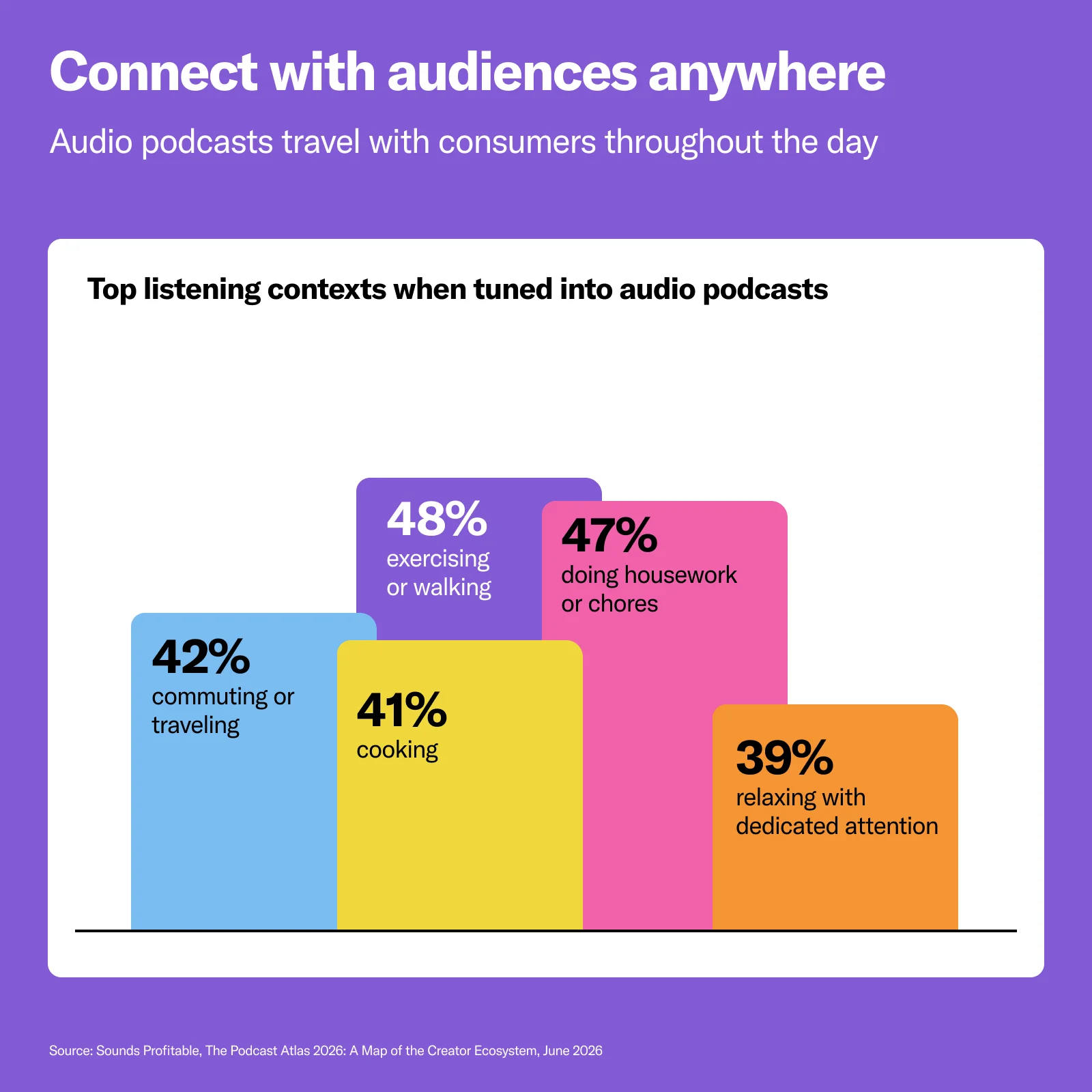
And that’s exactly where audio’s intimacy comes from. Podcast hosts become constant companions during the repetitive moments of everyday life—on the morning commute, while waking the dog, or while doing laundry. Over time, that repeated presence can build a sense of connection and trust in a way that’s difficult for other formats to replicate.
Video owns the pause
Video shines when consumers can visually connect with the podcast. Relaxing, eating, or winding down in bed provide perfect moments to settle in and watch. Yet, video is also highly adaptable. Even while doing housework or chores, consumers can lean into video when a screen is nearby. In fact, 77% of video podcast viewers say they tend to multitask while watching. 2
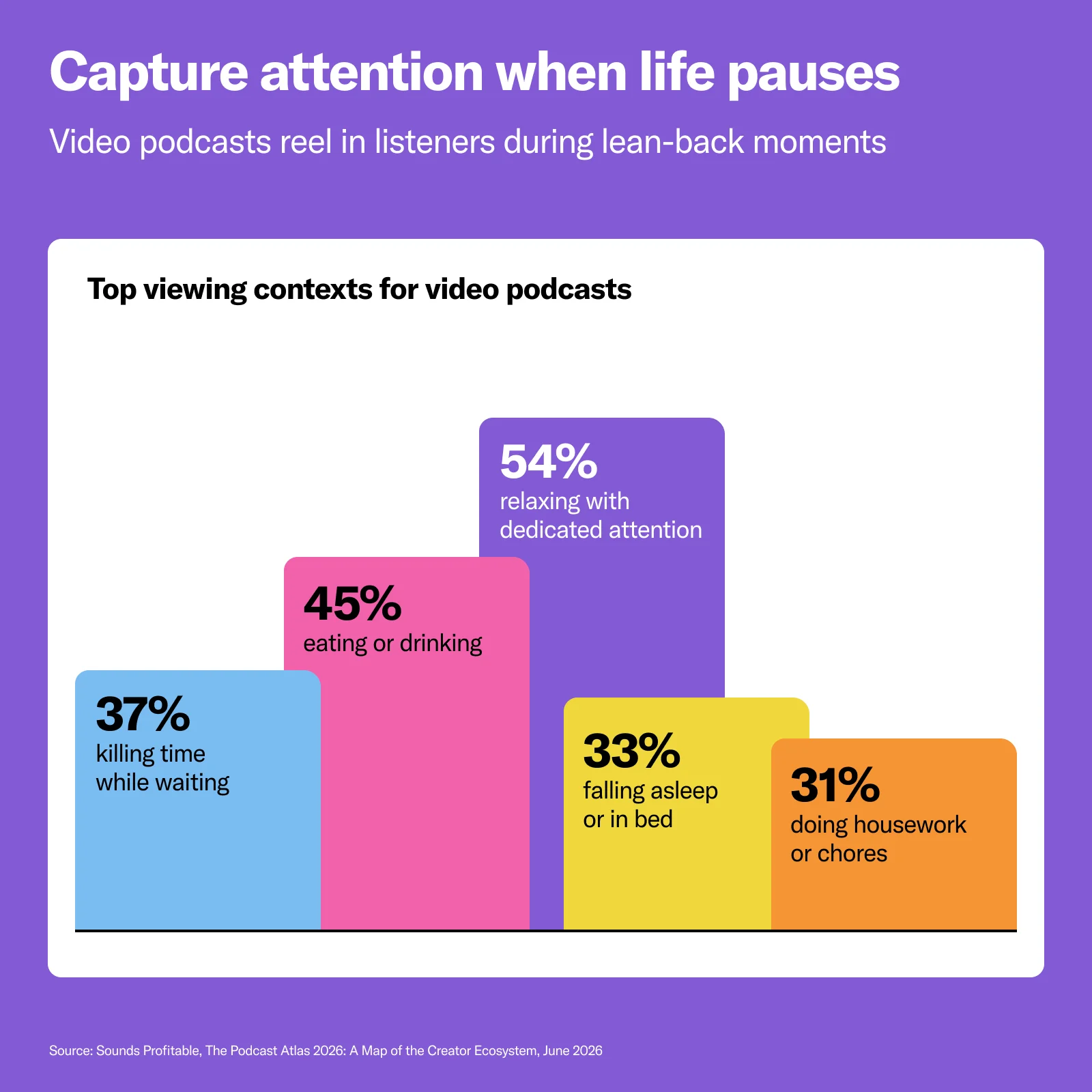
When you zoom out, it’s clear how these two formats tag-team the day in complementary ways. Audio builds familiarity and trust through consistent companionship, while video deepens that relationship by adding a visual layer when audiences have a screen nearby. In fact, 60% of video podcast viewers say that seeing hosts and guests provides context they don’t get from audio alone. 2 Rather than replacing the audio experience, video expands it by adding facial expressions, body language, and visual cues that make the podcast feel more immersive. This dynamic creates a continuous cycle of engagement, allowing connection and trust to deepen over time. That’s what makes podcasts so effective.
The creator is the bridge
Audiences may move between listening and watching, but their relationship with their favorite creators remains constant. That trust allows hosts to bring their audiences with them across formats. In fact, 73% of podcast listeners say they would probably or definitely follow a host from audio to video, 1 and 43% say podcasts help them connect with their favorite creators across audio, video, and social media. 2 It comes down to this: Audiences follow the voices, personalities, and communities that make them feel connected.
And SiriusXM Media helps advertisers tap into that connection through some of the industry’s most influential voices, including Conan O’Brien, Alex Cooper, and Mel Robbins, giving brands a powerful way to extend their reach across formats while preserving the authenticity of the creator-audience relationship.
But reach is only part of the opportunity. Audio and video capture attention and influence audiences in different ways. The data reveals that audio maintains an advantage in credibility, beating video in perceived factual accuracy (58% vs. 55% for video). 1 At the same time, video excels at turning that credibility into action, slightly edging out audio across several post-ad actions: brand searches (35% vs. 34% for audio), promo code use (20% vs. 18%), and immediate purchases (15% vs. 10%). 1 True effectiveness means looking at the big picture and using the specific strengths of each format to maximize brand impact.
So, what does that look like? While the format shapes how a message is delivered, the creator’s authentic voice remains the anchor. Audio makes the message memorable through clear verbal benefits, simple calls to action, and promotional codes that are easy to recall. Video makes the message tangible through product demos, on-screen visuals, and authentic facial expressions. No matter the format, the creator is what ties both experiences together.
The mode changes, but the impact holds
We’ve seen how audio and video tag-team the day, but benchmark data shows they also work together to drive full-funnel brand impact. The Signal Hill Insights 2026 Benchmark Report found that audio and video podcast ads delivered the same lift in familiarity. While video formats showed a slight edge across brand rating, consideration, and purchase intent, the differences are relatively small. The largest gap is only two percentage points in purchase intent, reinforcing that both formats are highly effective and closely aligned in full-funnel performance. 3
Simply put, the data shows that podcast audiences remain highly receptive, whether they’re watching or listening. The results stay the same, no matter how people tune in.
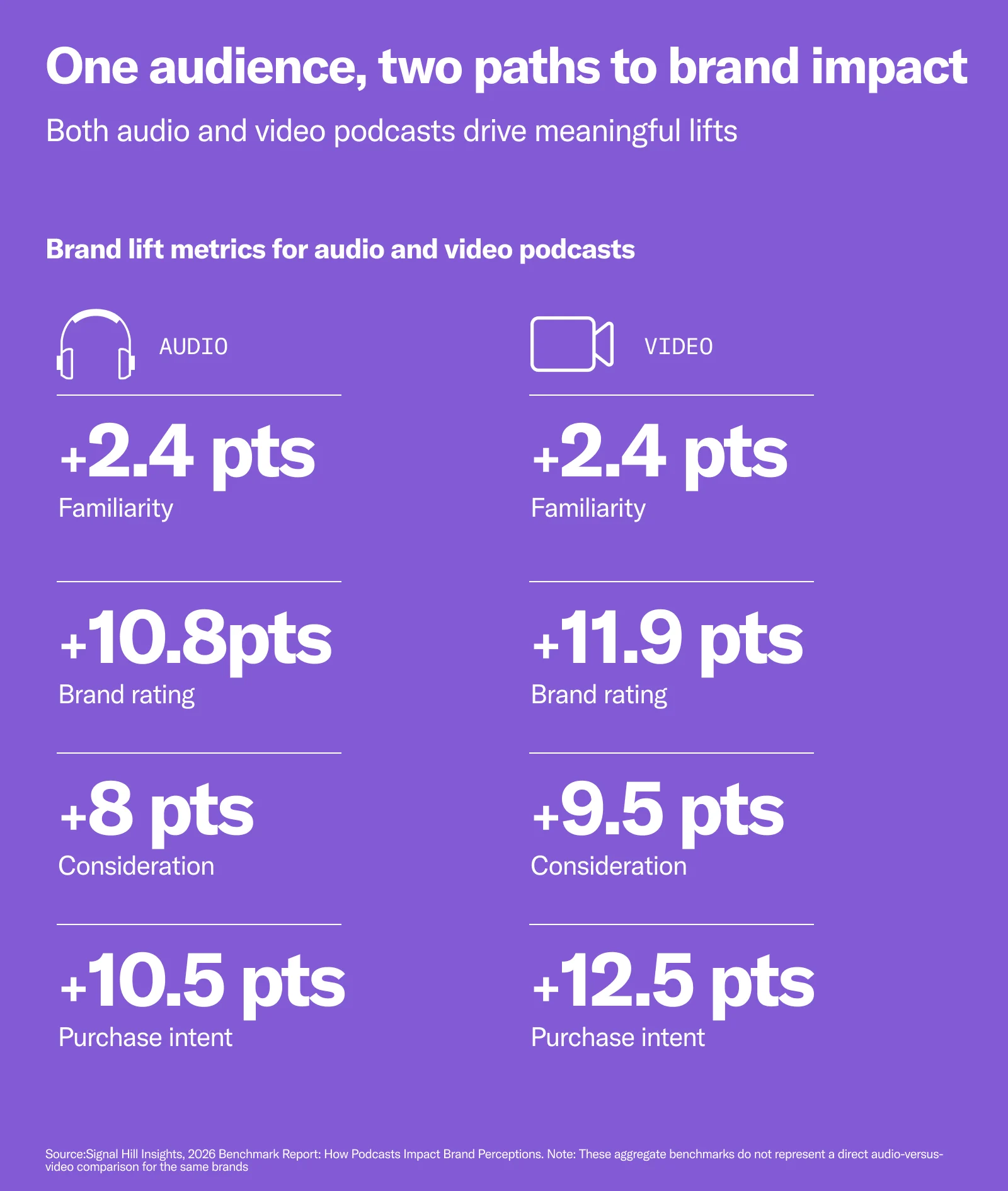
Again, the takeaway is not about choosing one format over the other. It’s about recognizing the value each format brings to the table. Audio integrates seamlessly into daily routines, while video adds visual context during screen-focused moments. The benchmarks show that both can translate podcast engagement into measurable impact, giving advertisers a powerful opportunity to influence consumers across the full podcast experience.
Follow the audience, not the format
The future of podcasting is not a battle between ears and eyes. It’s one audience naturally shifting between listening and watching based on the moment, device, and their available attention. Each mode creates a distinct consumption experience, but both sustain strong engagement, high episode completion, and meaningful connections with trusted hosts that drive brand impact.
Because audiences switch formats as their day unfolds, a winning strategy must play to the unique strengths of each medium. Audio should deliver clear, impactful messaging, and video must add real visual value. The truth is, the format will always change with the moment, but the creator, trust, and audience connection will remain constant.
With thousands of shows, more than 300 exclusive creators across every genre, and the status of the #1 podcast network, the SiriusXM Podcast Network helps brands follow audiences, not formats. 4 By connecting brands with the voices audiences know and trust, we create opportunities to build impact across every listening and viewing moment. Consumer behavior has evolved, and your podcast strategy should, too. Stop choosing between audio and video—let us future-proof your next campaign. Let’s talk.

More podcast advertising insights



Related Insights
 Targeting
Activity Targeting Gets Your Brand Messages in on the Action
Oct 16, 2026 Digital Audio
It's Not Too Late to Win New-to-Brand Holiday Buyers with Audio
Oct 15, 2026 Digital Audio
Why Fragmented Consumer Attention is Changing Media Buying
Oct 14, 2026 Success Stories
SiriusXM Drives Cross-Funnel Lifts for a Breakfast Brand
Oct 13, 2026
