Audio Advertising in Smart Speaker & Voice Assistant Ecosystems
Smart speakers and voice assistants have transitioned from novelty gadgets to essentials for many households. Over 100M Americans now own a smart speaker, 1and there’s been a +44% growth in ownership since 2020. 2 The opportunity for brands to reach audiences at home has never been more accessible.
These devices are reshaping where and when brands can connect with consumers. As connected home technology increasingly becomes the norm, advertisers need to understand how to craft messaging that resonate in this voice-forward environment.
Here’s what to know and the best practices for smart speaker-centric campaigns.
Why smart speakers matter in modern audio advertising
The rise of connected devices has reshaped how Americans consume audio at home. Smart speakers sit at the center of this ecosystem, serving as command centers for entertainment, information, and enhancing daily routines. The average US household now contains 21 connected devices—from voice-activated assistants to smart home appliances—creating multiple touchpoints for brands to reach consumers throughout their day. 3
Pandora has established itself as a leader when it comes to connected devices. Pandora’s connected home offering reaches 8M+ monthly unique visitors and offers 2K+ connected home device integrations. Additionally, 37% of Pandora listeners tune in to the platform exclusively on connected home, making the home setting a highly popular environment for listeners and brands alike. 4
These numbers tell a compelling story: Listeners are spending significant time with streaming audio through their smart speakers and connected devices, and they're doing so in environments where they're relaxed, engaged, and receptive to brand messages.
Designing ads for voice-forward environments
Creating effective voice-activated ads requires rethinking traditional advertising approaches. The screen-free nature of smart speakers demands fresh strategies. Here's how to optimize your messaging for smart speaker environments.
Consider the potential of co-listening
Smart speakers naturally facilitate shared listening experiences. While headphones or mobile devices are commonly used for solo listening sessions, smart speakers fill entire rooms, making co-listening the norm rather than the exception.
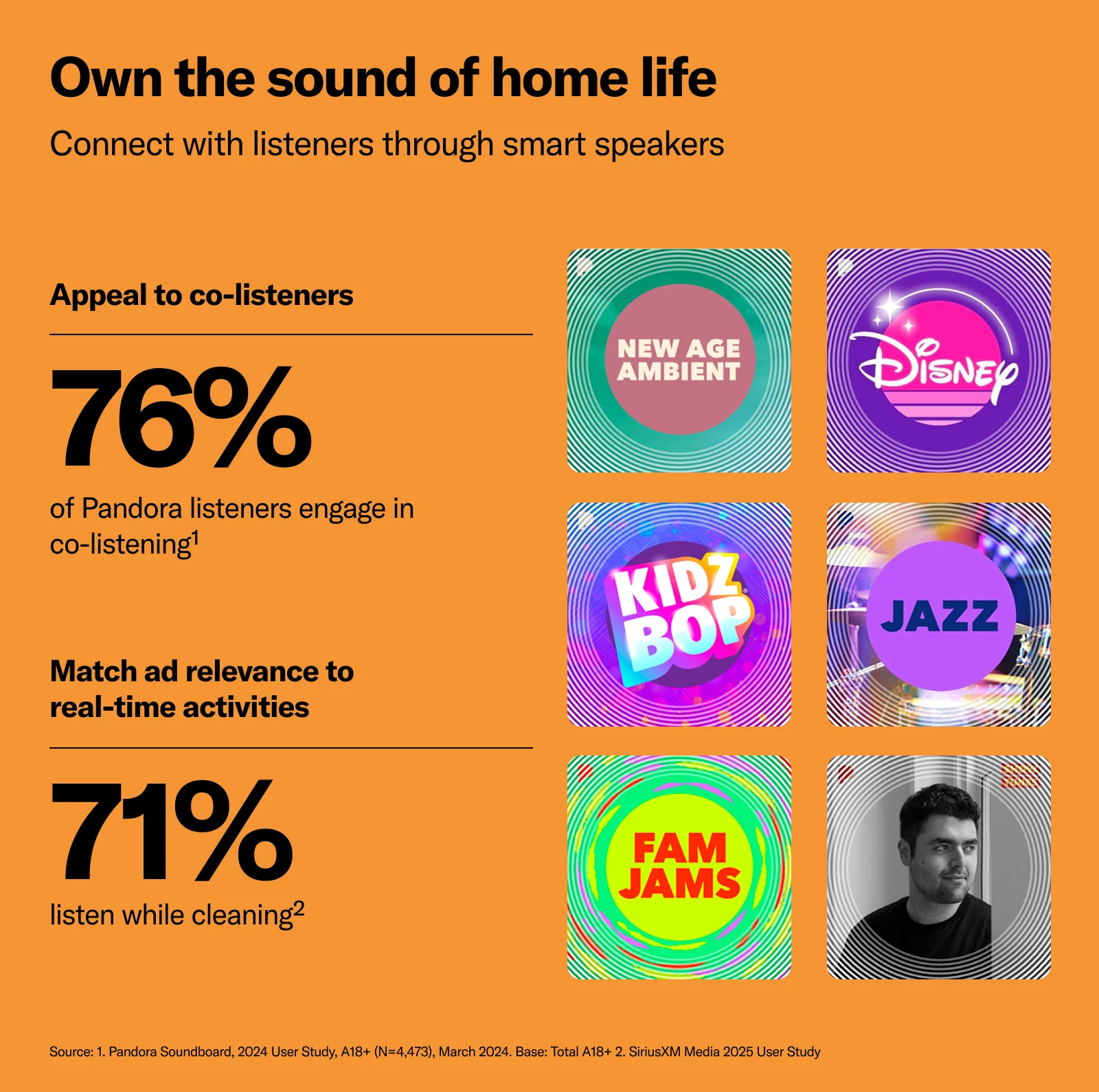
Parents are big fans of co-listening, with voice-activated device owners being +25% more likely to listen with children. And 82% of parents with children younger than 18 co-listen with them. When you factor in entertainment system owners, this number is even higher—90% of in-home audio entertainment system owners listen with others. 5
Whether users are co-listening with their family, significant other, or friends, these dynamics means your ad impressions multiply organically. When you reach a single smart speaker, you're often reaching an entire household—delivering additional value without additional cost.
Create ad relevance for real-time activities
Connected home listeners turn to audio during specific daily activities, giving brands the opportunity to align messaging with real-time contexts. Here’s how Pandora users multi-task while listening: 5
71% listen while cleaning
57% listen while cooking
44% listen while getting ready
These activity-based moments offer natural hooks for contextually relevant advertising. For instance, a meal kit service can reach listeners in the late afternoon when dinner is on their mind. Or a cleaning product brand might connect with audiences midday while they’re in the middle of tidying the house. The key is matching your message to the moment.
Deliver voice-activated CTAs
Traditional CTAs that rely on taps, clicks, or screen interactions simply don't work with smart speakers. These smart devices demand a different approach—one that prioritizes voice-activated responses.
Instead of "click here" or "visit our website," effective smart speaker CTAs include voice-activated phrases like "Ask for more info" or "Request a free sample." These verbal prompts complement the device's capabilities, creating frictionless paths to engagement. And you might even tweak your messaging to acknowledge that listeners are at home or incorporate sounds unique to the home—from the sizzling of a pan to the waterfall-like noises of a shower.
Understanding home listening habits and ad receptivity
Successful voice-activated ad campaigns begin with understanding how audiences use smart speakers throughout their homes. Different activities and genres attract various listener mindsets, each presenting unique advertising opportunities.
Leverage top home activities
Connected home listeners on Pandora engage with audio during these distinct moments: 6
Focus and studying: Students and professionals seeking concentration
Cooking and dinner parties: Families and hosts setting the mood for group meals and get-togethers
Wind-down: Individuals relaxing during their off time or after busy days
Reach co-listening households during these popular moments with stations like Fam Jams, Dinner Party, Lofi Study, or Preschool Nap Time. Advertising on these stations allows brands to reach households during shared moments, creating opportunities for co-listening impressions and group conversations about your product or service.
Reach listeners via their favorite genres
Genre preferences reveal listener priorities. The top genres for connected home listeners on Pandora include: 6
New Age
Children's
Classical
Jazz
Showtunes
Stations like New Age Ambient, Disney, Kidz Bop, Jazz Radio, and Showtunes attract dedicated audiences seeking specific atmospheres. Brands can use these content preferences to inform both their ad placement and creative approach. A wellness brand could naturally fit the New Age station, while children's educational products may align with Kidz Bop.
Targeting and personalization in voice-enabled audio
Smart speaker advertising opens up sophisticated targeting opportunities that go beyond traditional demographic segmentation. Here’s how you can reach your target listeners.
Get personal with contextual targeting
Activity and mood targeting allow brands to reach listeners based on what they're doing and how they're feeling—all in real time. For example, a workout supplement advertiser may promote their product during a listener’s high-energy workout. Or a sleep aid brand may serve an ad in a relaxation playlist when listeners are feeling calm—and likely ad-receptive.
These contextual targeting approaches respect listener privacy while still providing relevant, timely advertising experiences.
Reach diverse audiences with MC affinities
Connected device usage spans diverse demographics. When you’re homing in on diverse listeners, you can leverage our multicultural audience targeting options. This includes device owners in Black and Hispanic households, enabling brands to reach specific communities through their preferred listening platforms.
These targeting capabilities ensure cultural relevance and demonstrate respect for audience preferences and backgrounds.
Using voice-activated devices to drive sales lifts for a cleaning product advertiser
If you’re looking for real results, here’s proof. A premium cleaning product advertiser came to us to drive sales lifts among audio streamers 25-54, and we created a comprehensive streaming audio campaign. The campaign strategy leveraged a comprehensive media mix across Pandora, including:
Streaming Select mobile audio
Mobile video
Connected home
Rewarded ads
The campaign also featured promotional brand messaging with a strong CTA prompting listeners to ask their voice assistant for a free product sample.
Here’s what we pulled off: 7
+6.38% sales lift from mobile video
+2% penetration lift
+1.71% sales lift
This success story demonstrates how a combination of audience and voice-activated device targeting, compelling creative, and voice-friendly CTAs can deliver measurable results that exceed industry benchmarks.
Get started with SiriusXM Media
Smart speaker adoption (and usage) continues to accelerate, and forward-thinking brands are capitalizing on this shift. By targeting families and co-listening households who use connected devices, you can reach audiences during the moments that matter most.
Brands that embrace voice-activated advertising, targeted messaging, and contextual relevance will build stronger connections with the millions of Americans who've made smart speakers part of their daily routines.
Ready to amplify your message? Let's talk.
Unpack more connected device advertising insights



Related Insights
 Newsroom
Barometer Brings Advanced Brand Suitability Targeting to SiriusXM Media
Mar 24, 2026 Events
From Fandom to Influence: Our Time at SXSW and Podcast Evolutions 2026
Mar 24, 2026 Success Stories
The Sound Effect: Streaming Audio Drives Notable Sales Lifts
Mar 23, 2026 Streaming
Audio Advertising in Smart Speaker & Voice Assistant Ecosystems
Mar 23, 2026
