The Ultimate Guide to Audio Advertising
There are a million moments throughout the day when listeners tune in to audio. Whether it’s blaring their favorite celebratory playlist at a party or washing the dishes with their favorite podcast, connected listening is happening everywhere.
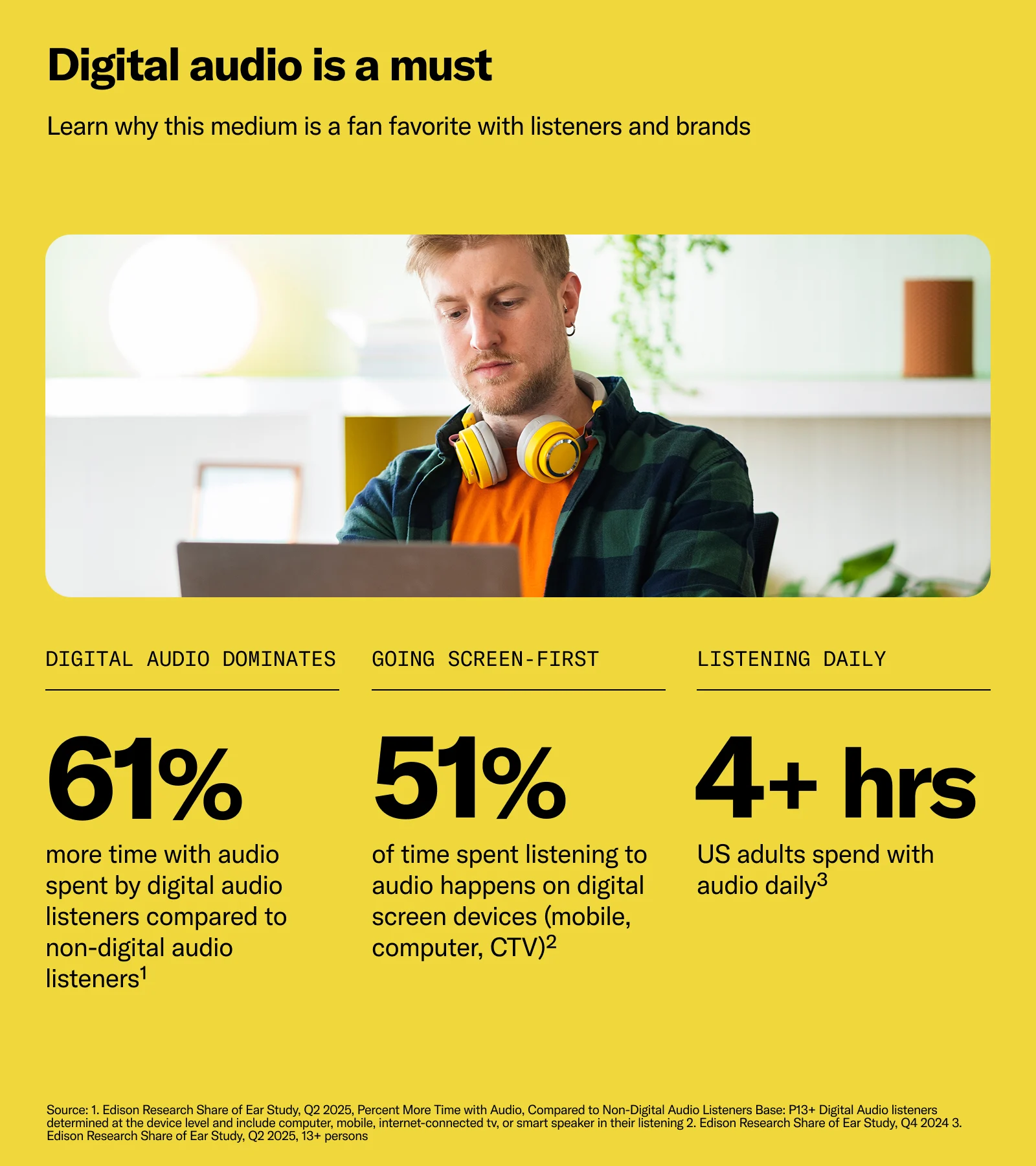
Digital audio's popularity is skyrocketing. Adults continue to increase their time spent listening—more so than other digital media. Americans are clocking in four hours per day with audio. 1 It’s no surprise that audio advertising remains more relevant than ever, and it expands the opportunity for more precise targeting and stronger brand connections with consumers.
Digital audio allows listeners to tune in from anywhere, and advertisers must capitalize on those magic moments of connection. So, what are the advantages of audio advertising, and how can we harness its power? Let’s get into it.
What Is Audio Advertising?
Audio advertising is the selling and insertion of ads in audio content, which can be streamed on a variety of devices. Traditional audio advertising, which includes broadcast or terrestrial radio, offers a broad reach and cultural legacy. However, these traditional forms of audio advertising have their limitations. Audio ads placed on these channels cast a wide net and don’t allow for reliable tracking and measurement of ad performance, making it difficult to determine a campaign’s effectiveness. Modern audio advertising (aka digital audio) occurs on channels like streaming audio, podcasts, and SiriusXM, enabling advanced targeting and measurement capabilities.
What Is Digital Audio Advertising?
Digital audio advertising is the insertion of ads into digital audio content, such as podcasts, satellite radio, and streaming music platforms. With digital audio listeners spending 61% more time with the medium than non-digital audio users, advertisers have the chance to cut through the noise and connect with audiences during their plugged-in moments. 2
One reason digital audio is so popular is because it helps listeners avoid screen fatigue, with the benefit of remaining connected and online. In fact, about 58% of young adults say audio helps them escape visual overstimulation. 3
In comparison to traditional radio, digital audio listeners are more engaged and listening through headphones, smartphones, and smart speakers. So, advertisers have the opportunity to deliver higher-quality, personalized, and relevant brand messages to make a bigger impression on target audiences.
How Does Audio Advertising Work?
Audio ads have evolved from simple radio jingles into modern, complex, and targeted digital ads. However, much of the ad formatting remains the same.
Get to Know the Formats and Placements
On streaming audio, ads are inserted within digital audio content in various formats. Brands can choose from audio, display, video, rewarded, sequential, and more. You might opt for a video ad to show your product in action, or you might pick a rewarded ad to encourage ad engagement with incentives. Audio ads can be as short as 10 seconds or as long as 60 seconds depending on your campaign goals and messaging.
On podcasts, host reads—where the host reads aloud the ad—are popular ad formats due to the connection that popular hosts form with their listeners. Three in four listeners prefer ads voiced by the podcast host, influencing their attention and ad receptivity. 4 And placement-wise, podcast ads can be placed before, during, or after an episode, also known as pre-roll, mid-roll, or post-roll.
A Brief History of Audio Advertising
How We Got Here
Over a hundred years ago, the first radio advertisement aired in 1922 on New York City’s WEAF. Far off from today’s short and condensed ads—at over 15 minutes long—listeners heard about the new apartments in Jackson Heights, Queens.
Jingles Are Born
General Mills is credited with the first-ever jingle for its cereal, “Wheaties–the best breakfast food in the land.” The jingle was played on Christmas Eve in 1926. However, it only aired in the Minneapolis-St. Paul market, causing Wheaties sales to skyrocket in the Twin Cities. The jingle saved the company from bankruptcy, and General Mills rushed to broadcast it nationally.
Many listeners grew to love specific jingles, like Alka Seltzer’s “Plop Plop, Fizz Fizz” (’76). Listeners also became accustomed to sponsored radio programs or live ad reads from hosts.
Streaming Audio Arrives
Streaming audio first stepped onto the scene in the 90s. From MP3 formats to peer-to-peer technology to iTunes, streaming audio has seen a major evolution over the past few decades. Fast forward to now: Listeners have access to near-endless content at their fingertips, while brands can create more targeted and measurable campaigns than ever before.
Podcasts Take Off
Then, when the first podcast appeared on iTunes in 2005, more targeted and niche opportunities arose. Podcasts presented an opportunity for personalized ads, and hosts can boost ad engagement by adding their own spin and personality to brand messaging.
As audio advertising continues to evolve, ads can now exist on multiple marketing channels on diverse platforms, devices, and formats.
The Advantages of Digital Audio Advertising
Audio advertising lays the groundwork for brands to have several points of connection with consumers, particularly in a personalized way.
Digital Audio Ads Can Be Heard Anywhere
Audio advertising doesn’t have the limits of other digital media—it’s more versatile. Over seven in 10 young adults listen to more audio content today because they can take it everywhere with them. 3 Audiences can play their favorite podcast during their morning commute, tune in to energetic mood music when they’re in the gym, or listen to the news as they cook dinner.
They Offer More Precise Targeting
Digital audio advertising guarantees more precise data. AM/FM can only gather general estimates about its audience’s demographics and location. Comparatively, when a listener logs into Pandora, advertisers can accurately gather verified data on demographics, location, and listening habits—so they can measure their campaigns better and know exactly who they’re reaching.
Additionally, contextual and activity data help advertisers create better and more effective ads. This data lets brands know when audiences are tuning into content and which device they use the most.
They Create Emotional Bonds
Have you ever put on a hype playlist to get yourself out of a funk or to prepare before a big event? Music, in particular, activates areas of the brain related to attachment, love, and compassion. Over seven in 10 listeners say that music improves their mood, and 75% say music relaxes them. 5 Those emotional connections formed with audio are a prime opportunity for advertisers to form a bond with their consumers.
Meanwhile, podcast hosts, SiriusXM radio show hosts and DJs can also become trusted messengers. A live read or a personalized endorsement by an authentic host will be better received by a specific audience compared to a standard announcer’s voice. Even though some podcasts have niche fans, catering to these communities can be highly rewarding, as these passionate listeners are attentively tuning in.
Final Takeaways About Digital Audio Advertising
From hearing radio jingles about Wheaties to using your smart speaker to learn more about a cereal ad, audio advertising has come a long way. Today, digital audio advertising provides an effective solution for advertisers looking to connect with diverse audiences in personal, tailored formats. As the advertising space continues to innovate, ads will only get better and better.
Ready to get started? Let's talk.
That’s Not All—More Audio Advertising Insights Here


Related Insights
 Targeting
What's the Vibe? How Mood Targeting Improves Your Ad Timing.
Oct 8, 2026 Events
Follow the Fandom: Inside the Built with Audio Event
Oct 7, 2026 Digital Audio
Audio Built for Every Kind of Audience
Oct 7, 2026 Podcasts
Serialously and 10 to Life Join SiriusXM Media: Meet Annie Elise
Oct 6, 2026
