
Sprite Hot Seats: Turning Sonic Science into Sensory Theater
- 65K
organic impressions from influencer social media posts
- ~600M
earned media impressions
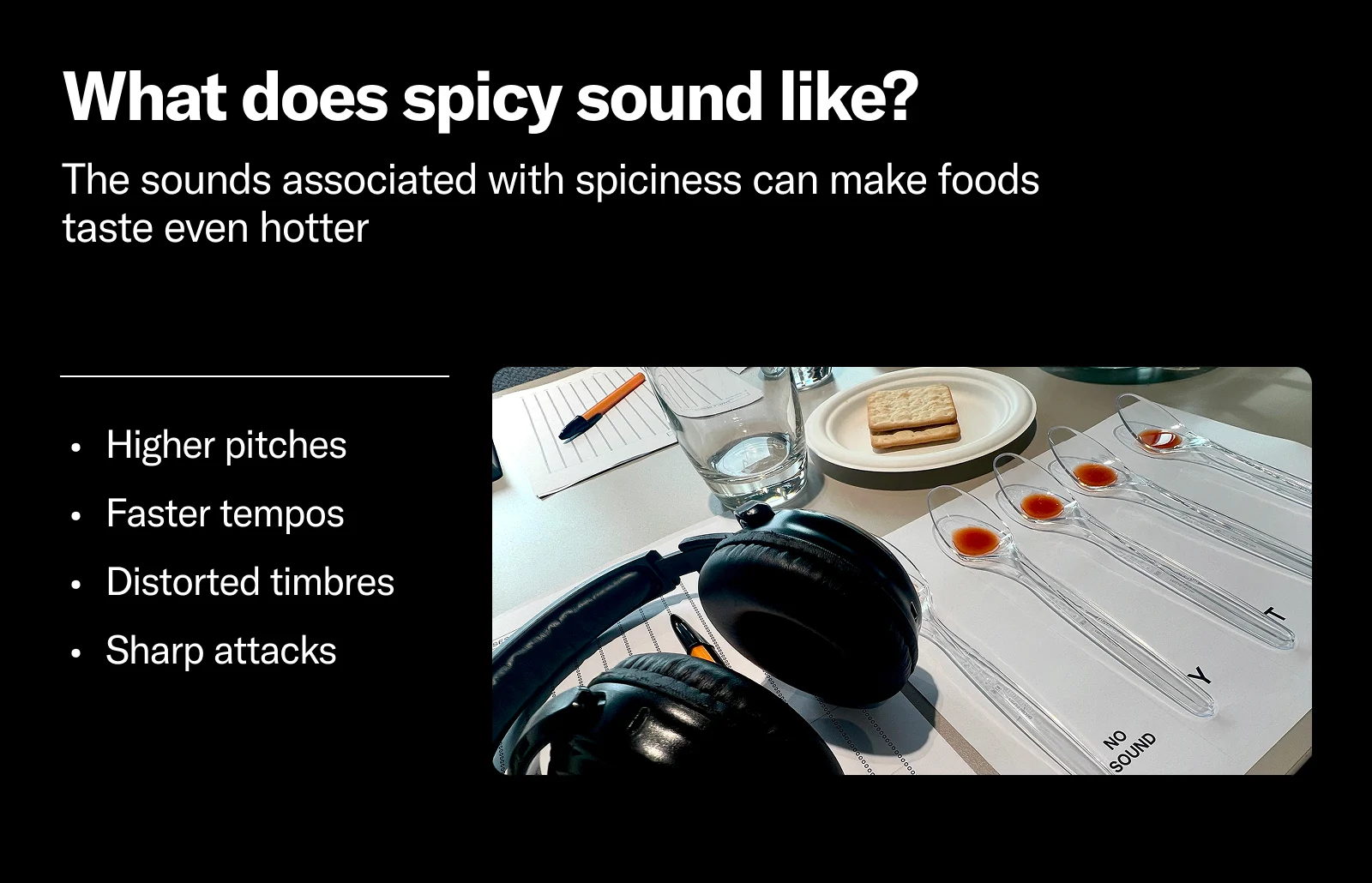
In a recent article, we explored the science of crossmodal perception. Specifically, how sound can function as an invisible ingredient, measurably changing our perception of flavor. We looked at how Professor Charles Spence’s decades of research at Oxford established the sonic signatures of basic tastes, and how Studio Resonate’s Steve Keller worked with Professor Spence and Dr. Janice Wang to identify the sonic building blocks of spiciness.
That research sat in the pages of peer-reviewed journals for nearly a decade, until Ogilvy UK came calling with a brief for Sprite.
The cultural opportunity
For Gen Z, spice is a cultural signal, tied to rituals that push personal limits. Over half of European Gen Z consumers eat spicy food more than once a week. With that kind of passion for all things hot, there was a massive opportunity to position Sprite as the go-to companion for everything from hot wings, to spicy dishes, to hot sauces.
But with that opportunity came a challenge. When the heat hits, conventional wisdom has us reaching for beer or milk, beverages that typically dull flavor and diminish the thrill of a spicy meal. If Sprite could credibly claim the role of the perfect companion to a spicy meal, it could significantly grow weekly drinkers and reposition itself as an essential mealtime choice. But Gen Z is skeptical. They don’t take brand claims at face value. Sprite couldn’t simply say it was “the perfect companion to a spicy meal.” It needed proof.
The Spice Lab
For the evidence, Studio Resonate partnered with Ogilvy UK to create the Spice Lab, where 200 Gen Z participants were put through controlled experiments over the course of two days to better understand how Sprite interacts with spicy food.
The first test explored how effective Sprite was at reducing oral burn compared to still water, sparkling water, and milk. The results were decisive. Not only did Sprite best still and sparkling water, it proved just as effective as milk in reducing burn within the first ten seconds of consumption, exactly the window when people need relief most.
The research team attributed this to a combination of factors. Sprite’s lemon-lime acidity helps mitigate the sensation of heat, while sweetness plays a balancing role. And the effervescence heightened arousal without completely eliminating the thrill of the burn.
These insights led to a powerful positioning for the brand: Sprite as a “burn balancer” that delivers immediate relief even as it sustains the thrill that spice lovers seek.
The audio effect
The next step was to explore the interplay between sound, spice, and Sprite. The team paired spicy food samples with different soundscapes (spicy, sweet, pleasant, and unpleasant) and tested their effects on the perception of heat, with and without Sprite.
What they discovered was striking. A spicy soundscape on its own heightened the perception of heat. But when that same spicy soundscape was paired with Sprite, the opposite effect occurred: the perceived cooling intensified, and the burn dropped off more rapidly. In other words, sound wasn’t merely influencing taste, it was interacting dynamically with the product experience itself. The crossmodal science that Steve and his colleagues had published years earlier evolved from academic finding to brand mechanism.
The Hot Seats
To bring the science to life in a real-world setting, sensory design pioneers Bompas & Parr were commissioned to create four Sprite Hot Seats: the world’s first audio-driven dining chairs engineered to influence the perception of spice.
Each chair was a multisensory tour de force, combining sound, sight, touch, and smell into a single superadditive experience. Grammy award-winning composer Ross Garren created a bespoke seven-minute soundscape calibrated to the sonic parameters of piquancy, which was delivered through speakers built directly into the chairs. LED lighting shifted from Sprite green to fiery red as the experience intensified. Textured, subtly uncomfortable surfaces added a tactile edge. And diffused chipotle aromas, released with smoke from the chairs during the meal, completed the sensory hack.
The effect was designed to amplify the natural burn of a spicy meal, making Sprite’s balancing properties more visceral, more immediate, and more impossible to ignore. Diners didn’t need to be told Sprite balanced the burn. They felt it.
The impact
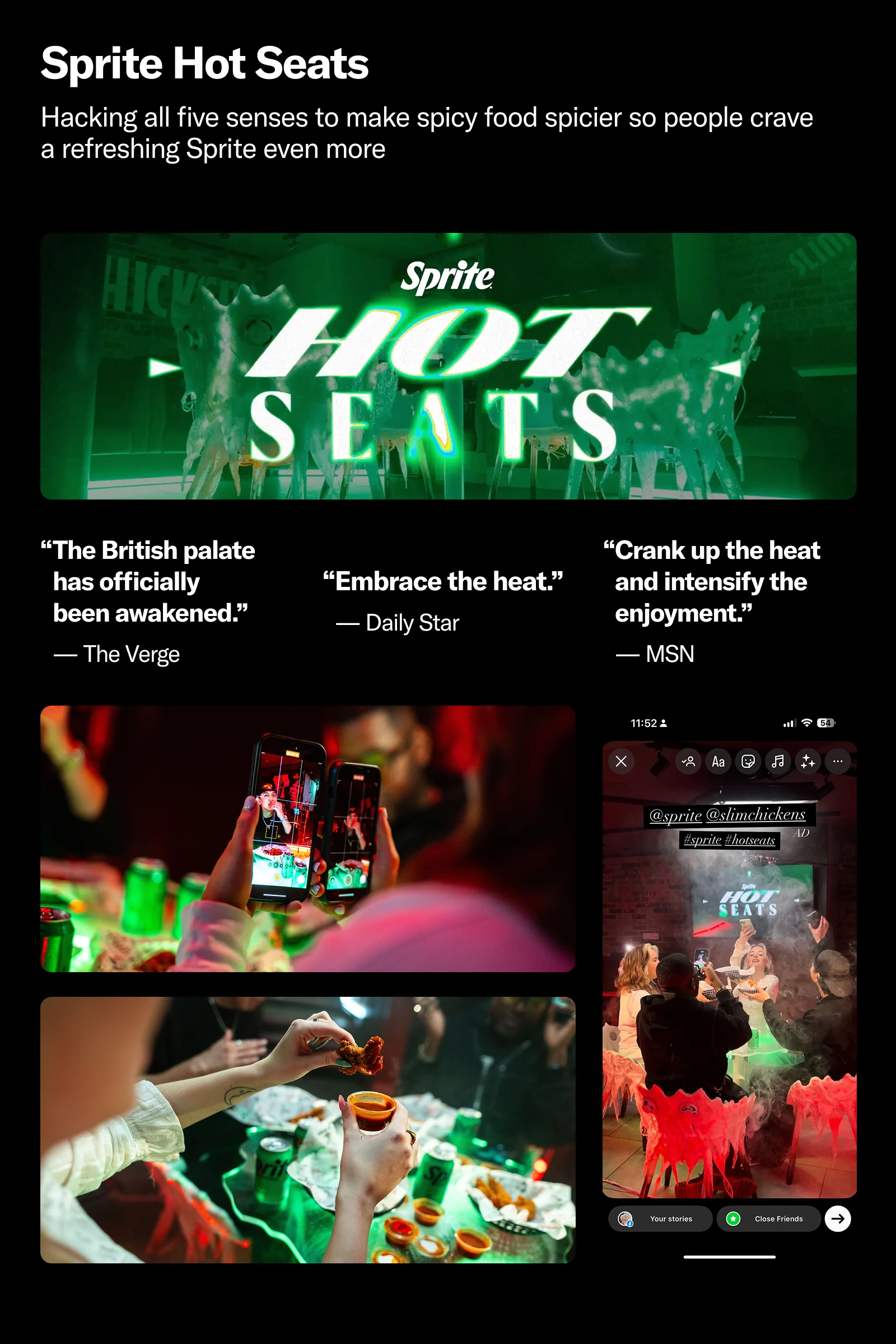
Sprite Hot Seats debuted at a two-day live event staged at Slim Chickens in central London, chosen for its spicy menu and popularity with Gen Z consumers. Bookings were offered online via Eventbrite and sold out in under an hour, driven by scarcity and targeted amplification through Slim Chickens’ app and email database.
Four major UK influencers documented the experience across 19 posts, generating over 65,000 organic impressions. The spicy soundscape was released globally on SoundCloud as an always-on cultural asset. National media picked up the story, including The Verge, Daily Star, and MSN, drawn to the provocation of science made visceral and impossible to ignore.
In total, Sprite Hot Seats generated nearly 600 million earned impressions. More importantly, Sprite shifted its role in culture: from generic refreshment to the essential spicy meal companion, from passive beverage to active burn balancer, and from commodity choice to conversation driver for Gen Z spice lovers.
Sprite Hot Seats is an example of what’s possible when audio-first thinking, rigorous science, and provocative creativity operate together.
Ready to build an audio-first campaign that turns up the heat for your brand? Let’s talk.
Dig into more from Studio Resonate


Related Insights
 Success Stories
A Sports Drink Brand Scores with Football Fans on SiriusXM
Oct 5, 2026 Success Stories
The Mel Robbins Podcast Drives Sales for a Personal Care Brand
Oct 1, 2026 Podcasts
Podcasts: One Audience, Two Formats, Shared Impact
Sep 29, 2026 Events
The Format Wars Never Happened: Why Audio and Video Are Growing Together
Sep 28, 2026
