Building an Audio Media Plan That Aligns With Goals
For years, there's been a disconnect between how much time consumers spend with digital audio and how much marketers invest in it. While most people are listening to streaming audio and podcasts (with this number only growing), many media plans have continued to prioritize more traditional channels.
That's finally changing. Single-channel thinking is starting to look like a relic, and audio is earning its place at the table. As marketers move beyond single-channel strategies, digital audio has become an essential part of an integrated media mix—working alongside video, social, display, and other channels to extend reach, reinforce messaging, and improve campaign performance across the consumer journey.
Here's the reality: 233M Americans ages 12 and up tune into online audio every month, 1 and they're spending over four hours daily with it. 2 That's a huge, attentive audience.
The question isn't whether audio deserves a place in your media plan—it's how to build an audio strategy that aligns with your business goals and complements the rest of your marketing investment. Let's walk through it.
What goes into an audio media plan?
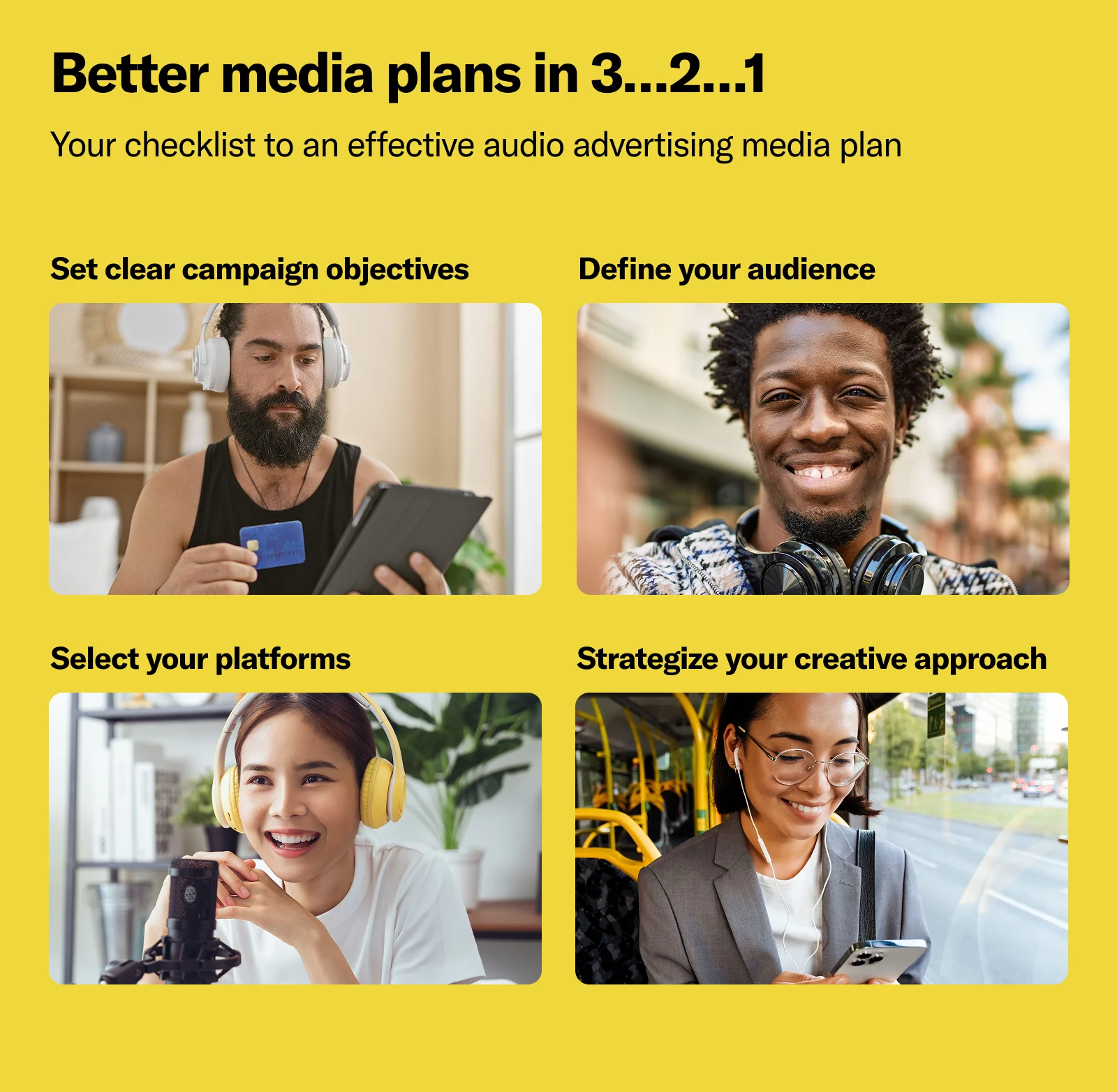
Set clear campaign objectives
Before anything else, figure out your goal. Are you trying to build awareness? Increase consideration? Or close the deal and drive sales?
These goals map directly to the three stages of the marketing funnel. At the top of the marketing funnel, you're introducing yourself to new audiences. In the middle, you're building a relationship and showing why you're different. At the bottom, you're encouraging action. Digital audio can support each stage, but your targeting, messaging, and creative should align with the outcome you're trying to achieve.
Define your audience
Once you know your goal, nail down your audience. This is where digital audio gets especially powerful. You're not limited to basic demographics like age and location. You can target listeners based on what they're listening to, their mood and activity, and many other signals.
Listening behaviors help reveal valuable audience insights. Someone streaming business podcasts during their morning commute may have different motivations than someone listening to wellness playlists on the weekend. These behaviors help marketers reach people in relevant moments with messaging that fits what they're already engaged with. You're not targeting content. You're finding people whose habits tell you who they are.
Pick your platforms
Describing audio as one thing is selling it short. There’s streaming audio, podcasts, satellite radio, live sports, and talk programming. Each category and platform reaches different people in various ways. The most effective audio media plans often combine multiple formats to maximize both reach and frequency.
Cross-platform planning can also help reduce audience duplication. For instance, the SiriusXM Podcast Network has almost no audience overlap with SoundCloud, Pandora, and SiriusXM digital. That means you can extend your reach across multiple platforms and target new people, not the same listeners over and over.
Strategize your creative approach
Targeting only gets you so far. Your creative has to actually resonate. Start by thinking about your sonic strategy. A study found that sonic brand cues (like a distinctive jingle or sound logo) are 8.5x more likely to create high-performing ads. 3 People are likely to remember what they hear.
Next, consider how your message unfolds. One approach that works well is sequential audio advertising, where you tell a story across multiple ads instead of cramming everything into one spot. Build curiosity in the first ad, reveal more detail in the second, and close the campaign with a clear CTA.
How audio supports every stage of the marketing funnel
You don't want to dump your entire budget into one tactic. Match your spending to what you're trying to achieve at each stage of the marketing funnel.
Top of funnel: Getting noticed
When you're focused on awareness, you want reach and frequency. The good news: Audio is great at introducing brands to new audiences. In fact, 89% of digital audio listeners have potentially learned about a new brand, product, or service from an audio ad. 4
Streaming audio is especially effective here because it delivers broad reach at scale, helping you get your message in front of fresh ears. Your awareness dollars work harder in audio while reaching highly engaged listeners.
Middle of funnel: Building interest
Once people know you exist, you need to give them reasons to care. This is where storytelling becomes especially important. Podcasts shine at this stage because listeners develop strong connections with their favorite hosts. Just look at the data: 68% of our podcast listeners say they're more open to considering products and services they learn about on podcasts compared to social media, live TV, or radio. 5
And when you tap into host reads, these ad types feel like recommendations from a trusted friend, and that trust carries weight.
Bottom of funnel: Driving action
When people are close to making a decision, audio can be the nudge that gets them to take action. Because audio is woven into daily life (multitasking, workouts, chores, and me time), it catches consumers when they're ready to take the next step.
Nearly eight in 10 (77%) digital audio listeners have potentially purchased a specific brand, product, or service after hearing an audio ad. 6 That's why audio isn't just an awareness channel—it can help move consumers all the way from awareness to action.
The role audio plays in performance and brand campaigns
There's an old idea that audio is only good for brand awareness. But modern audio advertising is effective for full-funnel marketing.
Audio continues to be a powerful brand-building channel. SiriusXM Media campaigns drive +8% lift in ad awareness and a +5% increase in message association. 7 The intimate nature of listening helps create connections that can be difficult to replicate in more crowded digital environments.
But audio also delivers measurable performance outcomes. Our campaigns have seen results like +3% increase in purchase intent and a +3% increase in brand favorability. 7This shows that audio can influence both perception and action when paired with the right targeting and creative.
You don't have to pick between brand and performance. Audio supports both.
How audio fits into your broader media mix
Audio works best when it's part of a larger plan, not siloed off on its own.
Incremental reach
One of audio's biggest advantages is incremental reach—the ability to connect with people your existing media plan may be missing. We’ve found that adding streaming audio and podcasts to a SiriusXM campaign can generate +142% incremental reach. Additionally, adding SiriusXM and podcasts to a streaming audio campaign delivers +89% incremental reach. 8 Instead of repeatedly reaching the same audience, you're expanding your campaign to new listeners.
Cross-channel effectiveness
If your audience keeps seeing the same display ads, audio offers a fresh touchpoint and strengthens other media. It complements video, social, and display by reinforcing your message across different environments and helping manage frequency more effectively. We’ve found that adding video and display ads to an audio-only campaign can deliver +52% incremental reach. 9 By combining different formats, you can keep your messages from getting stale.
Engagement quality
Audio reaches people during screen-free moments—when they’re in the car, at the gym, or making dinner. Because listeners are often engaged with the content they're hearing, brands have an opportunity to deliver messages in moments that feel less cluttered and more memorable. That focused attention can translate to better recall and stronger engagement.
Business outcomes
You can measure far more than impressions with audio. Brand lift studies show how campaigns affect awareness, consideration, favorability, and purchase intent. Attribution and conversion measurement can reveal actions like website visits, app downloads, and purchases. Location analytics show whether ads are driving foot traffic. Sales lift studies tie advertising exposure to revenue, giving marketers a clearer picture of business impact instead of relying on assumptions.
Build a media plan that actually delivers
Putting together an effective audio plan comes down to planning. Start with clear goals, get specific about your audience, choose the right mix of platforms, and create ads that people actually want to hear. Then, track your results and keep optimizing.
When you get it right, audio becomes one of the most reliable tools you have for moving listeners from awareness to action.
Ready to put a plan together? Let's talk.
More audio advertising insights


Related Insights
 Targeting
What's the Vibe? How Mood Targeting Improves Your Ad Timing.
Oct 8, 2026 Events
Follow the Fandom: Inside the Built with Audio Event
Oct 7, 2026 Digital Audio
Audio Built for Every Kind of Audience
Oct 7, 2026 Podcasts
Serialously and 10 to Life Join SiriusXM Media: Meet Annie Elise
Oct 6, 2026
